“Got the Ick?” How Reality TV Affects Relationships
A relationship therapist explains how the “Love Island effect” is changing our dating vocabulary and affecting modern dating culture.
The Love Island Effect
It’s summer, which means iced coffee, Factor 50, and…Love Island. Yes, this year, like every other year, we’re finding ourselves in the throes of a full-blown Love Island obsession: watching some of the world’s hottest singles battle it out in tiny bikinis, all for the sake of love. But as these reality TV shows gain popularity, they’ve transcended guilty pleasure to become something of a cultural phenomenon.
What Is the Love Island Effect
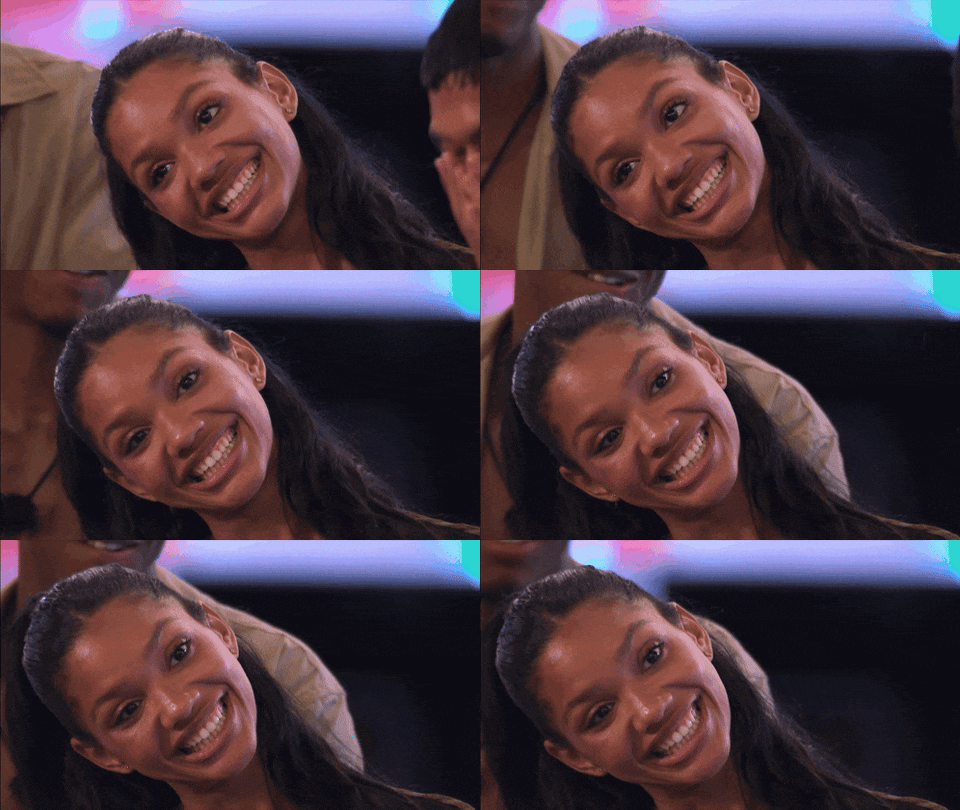
The “Love Island effect” refers to the influence reality dating shows, like Love Island, have on the way viewers think about things like desire and dating. From introducing phrases like "the ick" to shaping expectations around romance, these shows have become part of everyday conversations about relationships.
But for those of us obsessed with the relationship dynamics of reality TV shows like Love Island, our consumption doesn’t end when the credits roll. We communally consume each episode and analyze afterwards like it’s critical theory: dissecting each character and moment in our group chats like we’re writing a dissertation, defending or condemning contestants’ behaviour over matcha like we’re public defence attorneys.
Given the deep social resonance of these shows, conversations have emerged in recent years among viewers and relationship experts about how reality TV affects relationships—not just those of the contestants but us, the viewing public, too.
So how have these dating shows changed how we view all things love and lust? Keep reading for your Lustery POV guide to how reality TV affects relationships, according to a sex and relationships therapist.
Watch Real Couples Compete in the First Adult Reality TV Show
Relationship Education Thanks to Reality TV
Have you ever met a fan of dating shows who hasn’t been a great person to a) vent to about your latest situationship and b) give you advice on what to text your crush? Yep, we thought so, and that’s because reality TV teaches us about different relationship dynamics and how they play out in real life.
A study on reality TV and romantic relationships suggests that reality TV affects how we approach dating. It showed that it encourages teenage girls and young women to expect higher levels of respect within romantic relationships.
There are plenty of other ways that our viewing habits impact our personal lives, and much of it begins with our vocabulary and the words and phrases we learn from shows like Love Island: terms which are slowly reshaping how we think and speak about dating.
Below, sex and relationship therapist and educator Nikki Scott goes deep on how reality TV is changing our relationships, one term at a time.
Peek Behind Closed Doors — Watch Real Amateurs




Reality TV Has Changed Our Dating Vocabulary
Watch any reality TV show about love or dating, and you’ll notice a familiar pattern: contestants all start speaking what seems like their own secret language. Or, maybe that’s a bit extreme, but there is a shared lexicon among the singles to describe the unique circumstances or rules of the show they find themselves in. I think we’re all still trying to figure out what Love Island USA’s french fries means!
When we watch shows like Married At First Sight or Love Island, we pick up on this and absorb some of the words and terminology being beamed through our TV or laptop speakers. According to Scott, these new terms aren’t just a fad. Rather, they are broadening the way we talk about how we form connections IRL. “Reality dating shows have done something genuinely useful: they've given us a shared shorthand for feelings we didn't have language for before,” Scott explains.
“Reality dating shows have done something genuinely useful: they've given us a shared shorthand for feelings we didn't have language for before,” Scott, a sex and relationships therapist, explains.
Indeed, as we watch contestants grapple with the nuances of emotion and commitment in real time, we begin to pick up on words that might help us decipher complex dating situations. “Connection is rarely black and white; there is a lot of grey, and all deserves space to be talked through,” Scott says. “Most of us were never taught to articulate the physical sensation of attraction, or its absence. These shows accidentally built us a starter dictionary.”
When we all have shared vocabulary, we’re able to communicate more effectively, not just with others but with ourselves. “What I find genuinely valuable about this vocabulary isn't the words themselves; it's that they've given people permission to name a feeling in real time, out loud, to friends. To talk about the messy middle of building relationships. That's something.”
“Most of us were never taught to articulate the physical sensation of attraction, or its absence. These shows accidentally built us a starter dictionary.”
So, what are some of the terms that have emerged from the world of reality TV?
Reality TV Dating Terms Explained
“My Type on Paper”
Another phrase that any reality TV fan will recognize is “my type on paper”: the idea that a prospective partner possesses all of the physical and emotional attributes you’re looking for, but that there’s still no chemistry between you.
Scott recommends using the word with a degree of caution. “‘My type on paper’ is another phrase worth unpacking. It describes someone who ticks every logical box: job, height, values, but the initial connection is void of the spark,” she explains. “I'd argue this phrase has done a lot of quiet damage, because it implies chemistry and compatibility are separate categories you're choosing between, when actually the healthiest relationships tend to have both, just not always instantly. It also lets people dismiss a decent connection too early because it didn't arrive with fireworks attached.”
“The Ick”
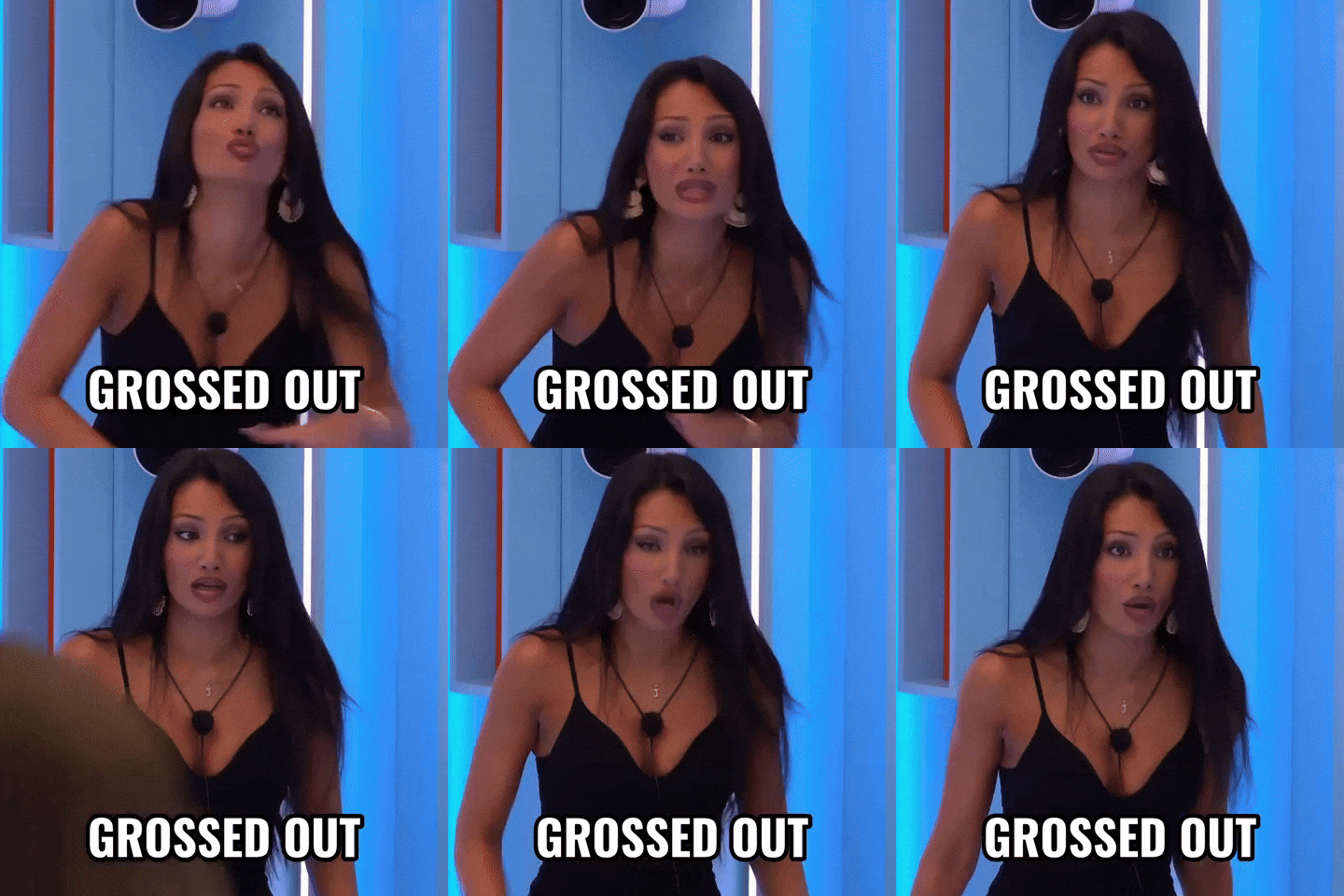
We can’t talk about dating shows without bringing up “the ick”: a phrase which articulates that gut feeling of feeling turned off by a romantic or sexual partner.
However, Scott emphasizes that the meaning of the word only tells one part of the story. “The ick [is] that sudden, visceral turn-off triggered by something completely mundane, the way someone laughs, orders a drink, talks to a waiter, does their hair…” she says. “It's become a catch-all, but what's actually happening is often more interesting than the word suggests.”
In order for the word to bring clarity about our dating intentions, we need to interrogate what it might mean: being honest with ourselves about what we really feel. “Sometimes the ick is genuine incompatibility surfacing in a split second. But sometimes it's intimacy anxiety in disguise, a nervous system finding a socially acceptable exit route the moment things start to feel real,” Scott explains.
“Doing it for the plot”
The changes wrought by reality TV are often more abstract – and wider-reaching – than just the words we are using to describe our dating lives. In recent years, we’ve seen the spectacle of dating shows migrate closer to home, as more of us have our own romantic lives into content: broadcasting them on the internet.
Of course, a central part of dating was always gossip, but content relaying personal relationship or dating stories, or even featuring real screenshots from conversations on dating apps, has become increasingly popular. Even expressions of love or romance are becoming more extravagant, and minutely planned out for social media rollouts.
Sometimes, this type of content focuses on recounting mishaps with individual people – remember West Elm Caleb, the NYC designer accused of shady dating behaviour on TikTok? Or the ‘Tabi Swiper’ who allegedly stole his Tinder date’s shoes? – but other times it can manifest as breath-taking stunts, like the couple who recently scaled the Empire State Building to propose.
Increasingly, it feels like we’re not just following our feelings but, instead, dating “for the plot” (or at least for the content). Scott, like many of us, has mixed feelings about the contentification of dating culture. “There's something honest happening when people say they're ‘doing it for the plot’. It's an admission that dating can be genuinely absurd, and that finding the comedy in a bad date is a valid coping mechanism, arguably a healthier one than pretending every date has to be a serious audition for a life partner."
However, she notes that the performative aspect of modern dating can take us out of the moment and prevent genuine connection. “When a date becomes content before it's even finished, when you're mentally drafting the screenshot caption while you're still sitting across from someone, you're not actually in the date anymore. You're narrating it for an audience,” Scott explains. “That shift matters, because intimacy requires a kind of undivided attention that performance simply doesn't allow. You can't be fully present with someone and simultaneously be curating them for public consumption.”
Ultimately, Scott sees both positives and negatives. “So, better or worse? Genuinely both. Better, because we're talking about dating with more humour and less shame than previous generations managed,” she says. “Worse, because we've built an audience into an experience that used to be allowed to just be ours, and that changes how honestly we can show up inside it.”
As well as the zeitgeist-defining terms we’ve discussed above, there’s plenty of other lingo you need to know: check out our quick dating show dictionary below!
Quick Reality TV Dictionary
Closed Off
The step before ‘exclusive’ is ‘closed off’. It’s a loose promise to avoid actively seeking new attachments, but not quite a full-blown commitment as much as a statement of intent.
Mugged off
Something you might not realize is that some of Love Island’s favourite phrases are actually just British slang. This includes ‘mugging someone off’, which means disrespecting someone or treating them badly. In dating show terms, this might mean lying to a prospective partner or kissing someone else.
Head turned
‘Head turned’ is when you’ve found someone attractive and begun to develop feelings for them, especially when you also happen to already be in a relationship or have a connection with someone else.
Grafting
In the UK, ‘grafting’ is putting in hard work. In Love Island, it’s going to great lengths to make someone attracted to you or to gain their attention.
Crack on
Within the context of reality TV, ‘crack on’ means to begin pursuing a romantic relationship with someone and to actively flirt with whoever you’re interested in.
Have Dating Shows Improved Emotional Literacy?
While dating shows might have influenced the way we show up in relationships in various complex ways, they also impact our more internal processes: how we reflect on the behaviour around us and spot dating patterns.
Viewing prospective couples or established partners navigate topics like infidelity, incompatibility, lack of attraction, or miscommunication allows us to see how different dynamics play out, while also encouraging us to empathise with others. This has hugely impacted how many of us approach relationships, allowing us to evolve our understanding with time.
Reality TV Has Improved Our Relationship Vocabulary
Scott concurs. “Watching contestants name patterns out loud, avoidant attachment, love bombing, breadcrumbing, has genuinely improved public vocabulary around behaviour that used to just feel confusing or hurtful without anyone being able to say why,” she says. “People are walking into dates now with a working knowledge of red flags that simply wasn't common ten or fifteen years ago. That's a real gain, and I don't want to undersell it.”
The Risk of Over Diagnosing Relationships
However, there’s also a drawback to keep in mind: misusing jargon and unjustly villainising other people. “There's also a subtler risk I see in my own work: an over-diagnosing culture, where every date gets run through a checklist of buzzwords instead of being met with curiosity,” Scott adds. “Not every mismatch is a red flag. Sometimes it's just two people who wanted different things, and that's allowed to be true without a label attached to it.”
Emotional Literacy Requires More Than Watching Reality TV
Ultimately, there’s also a disparity between an awareness of different patterns and practising that emotional intelligence IRL. “Recognising avoidant behaviour in a stranger on your TV screen is a very different skill from staying regulated when your own attachment system gets activated by someone you actually like,” Scott says.
“Emotional literacy isn't just vocabulary; it's the capacity to notice what's happening in your own body, name it and respond accordingly. Behaviours that are built through experience, self-knowing and integrity, a learnt practice not something you just pick up through passive observation.”
What Reality TV Can (and Can't) Teach Us About Relationships
When it comes down to it, most single people – and those figuring out relationships – are students of the school of reality TV. The unique turns-of-phrase and terms have seeped into how we talk about dating, as well as how we discuss love and relationships online, and how we share our feelings with others.
But, as with anything, it’s worth recognising the good along with the bad, the mixed bag of human emotions that represents another type of ‘reality’: the messy condition of the human heart. Ultimately, as much as we turn outwards to discuss and explore our favourite shows, it’s also worth turning inwards to reflect on what our own values, views, wants and desires are – and doing our best to relate that to our own romantic lives.